Protocol
The Deep Reset Protocol
A 4-week sleep optimization program built around habits, timing, recovery, and supplementation.
Control the Night. Own the Day.
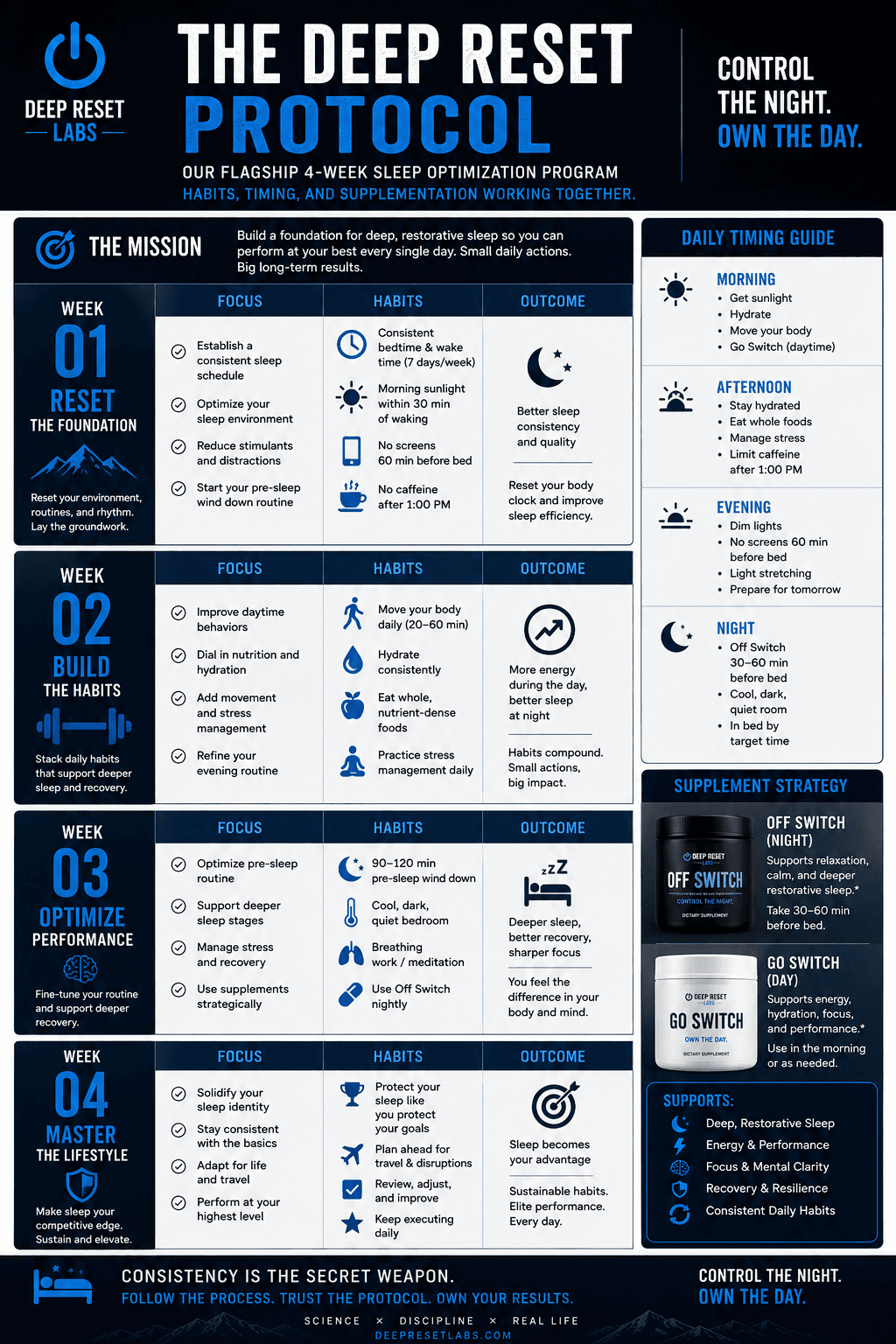
The Deep Reset Protocol is built around one central principle: sleep starts when you wake up.
Better sleep is not created by one thing you take 30 minutes before bed. Your sleep is influenced by your light exposure, movement, nutrition, hydration, caffeine, stress, environment, schedule, and nighttime routine.
Over the next four weeks, you will build those pieces one at a time instead of trying to change everything overnight. The goal is not perfection. It is consistency.
Build a foundation for deeper, more restorative sleep so you can perform at your best during the day.
Each week builds on the previous one. Continue stacking habits until they become part of your normal routine.
01
Week 1
Reset the Foundation
Establish Your Rhythm
- 1
Establish a Consistent Sleep Schedule
Choose a realistic target bedtime and wake time. Maintain these seven days per week whenever possible. Your wake time is especially important — it anchors your entire circadian cycle.
- 2
Get Morning Sunlight
Get outside within the first 30 minutes of waking. Aim for 5–15 minutes of outdoor light, with longer exposure on cloudy or darker days. Go outside. Walk around. Drink your water. Let your eyes receive normal outdoor light.
- 3
Optimize Your Bedroom
Cool room. Minimal light. Minimal noise. Comfortable bedding. Limited distractions. A temperature around 60–67°F is a useful starting point — adjust based on personal comfort.
- 4
Reduce Evening Stimulation
During the final hour before bed, reduce unnecessary screens, work, news, social media, and mentally stimulating activities. The goal is simply to make nighttime noticeably different from daytime.
- 5
Establish a Caffeine Cutoff
Start with a cutoff of approximately 6–8 hours before your target bedtime. Adjust earlier if you are particularly sensitive to caffeine. 1:00 PM is a simple starting example — your actual cutoff depends on your bedtime and caffeine sensitivity.
Don't chase perfect sleep. Chase consistency. By the end of Week 1 you should have a predictable wake time, morning light exposure, a defined caffeine cutoff, a better sleep environment, and a basic evening wind-down routine.
02
Week 2
Build the Habits
Own the Day
- 1
Move Every Day
Aim for 20–60 minutes of intentional movement most days. Walking, strength training, CrossFit, Jiu-Jitsu, mobility, cycling, hiking, or sports. Regular movement matters more than constantly pushing your body to its limit.
- 2
Hydrate Consistently
Start hydrating early rather than trying to catch up at night. Drink water after waking and continue throughout the day. Electrolytes can be useful during heavy training, sweating, heat exposure, or physically demanding work.
- 3
Eat to Support Recovery
Build most of your diet around nutrient-dense foods: protein, fruits, vegetables, quality carbohydrates, healthy fats, and whole or minimally processed foods. Avoid turning late-night eating into another source of stimulation or discomfort.
- 4
Manage Stress Before Bedtime
Build short periods of recovery into your day. That could mean walking outside, prayer, breathing exercises, meditation, journaling, reading, talking with someone, or taking a break from your phone. The objective is to prevent your nervous system from remaining in go mode all day long.
- 5
Refine Your Evening Routine
Begin developing a predictable sequence before bed. Your brain learns patterns. When the same sequence repeatedly ends in sleep, those behaviors become cues that the day is ending.
Stack your daytime habits on top of the foundation from Week 1. The objective: more stable daytime energy → better nighttime sleep → better recovery tomorrow.
03
Week 3
Optimize Performance
Fine-Tune Your Sleep
- 1
Create a 90–120 Minute Wind-Down
Start lowering stimulation before you are actually ready to sleep. Dim the lights. Finish demanding work. Reduce unnecessary screens. Prepare for tomorrow. Stretch or perform light mobility. Read. Journal. Pray or meditate. Let your body transition from performance mode into recovery mode.
- 2
Make the Bedroom Cool, Dark, and Quiet
Remove unnecessary light. Reduce noise when possible. Set the temperature to something comfortable and cool. Keep your phone from becoming the centerpiece of your bedroom. Your environment should communicate one thing: it is time to sleep.
- 3
Use Slow Breathing to Downshift
If your mind is still running, spend several minutes using slow, controlled breathing. Inhale for 4 seconds, hold for 4 seconds, exhale for 6 seconds. Repeat for several cycles without forcing the breath.
- 4
Protect Your Sleep Opportunity
Adults generally need at least 7 hours of sleep, and individual needs vary. If you are training hard, working demanding shifts, or carrying a high physical or mental workload, recovery becomes even more important.
- 5
Use Supplements Strategically
Supplements support the protocol — they do not replace it. Use Go Switch during the day to support hydration and performance. Use Off Switch approximately 30–60 minutes before bed as part of your nighttime routine. The objective: Off Switch → Lights Down → Stimulation Down → Bed → Sleep.
You are now combining circadian timing, environment, movement, nutrition, stress management, wind-down, and strategic supplementation. This is where the individual habits begin functioning as a complete system.
04
Week 4
Master the Lifestyle
Make Sleep Your Competitive Advantage
- 1
Protect Your Sleep Like You Protect Your Goals
Sleep is not time taken away from performance — it is part of performance. Treat your sleep schedule with the same seriousness you give your training, work, nutrition, and other priorities.
- 2
Stay Consistent With the Basics
Do not abandon simple habits because you have started feeling better. Continue morning sunlight, daily movement, hydration, smart caffeine timing, stress management, evening light reduction, and consistent sleep and wake times. The basics continue working even after they stop feeling exciting.
- 3
Prepare for Disruptions
Real life is not perfectly predictable. Travel happens. Kids wake up. Shift schedules change. Work gets stressful. You stay out late. One bad night does not destroy the protocol. Return to your normal routine as soon as practical instead of allowing one disrupted night to become an entire disrupted week.
- 4
Review Your Results
At the end of four weeks, look back at your journal or tracking data. How quickly are you falling asleep? How often are you waking at night? How do you feel when you wake up? How is your daytime energy, mood, mental clarity, and training recovery? Which habits made the biggest difference? The purpose of tracking is to recognize patterns, not to obsess over numbers.
- 5
Build Your Personal Deep Reset
Your final routine does not have to look exactly like someone else's. Keep the principles that consistently improve your sleep and adapt them to your actual life. The protocol should eventually feel less like a program you are following and more like the way you live.
Maintain what works. Adapt for real life. Sleep is now your competitive advantage.
Your Daily Deep Reset
The same framework, repeated every day.
Wake → Light → Hydrate → Move
Get outdoor light after waking. Hydrate. Move your body. Begin your day instead of remaining in a low-light, half-awake state. Use Go Switch during the day if it is part of your routine.
Fuel → Hydrate → Move → Manage Stress
Eat quality food. Continue hydrating. Get additional outdoor light. Move periodically. Be intentional with caffeine. Create moments where your brain is not constantly receiving stimulation.
Slow Down → Dim Down → Prepare
Begin reducing stimulation approximately 90–120 minutes before bed. Dim lights. Reduce screens. Finish stressful work. Prepare for tomorrow. Use light stretching, reading, prayer, journaling, meditation, or breathing to transition toward sleep.
Off Switch → Cool → Dark → Quiet → Sleep
Use Off Switch approximately 30–60 minutes before bed if it is part of your routine. Make the room cool, dark, and quiet. Get in bed around your target bedtime. Then let sleep happen.
Night
OFF SWITCH
Use approximately 30–60 minutes before bed as part of your nighttime routine. Pair with your wind-down environment: lights down, screens off, room cool and dark.
Control the Night
Day
GO SWITCH
Use during the day to support hydration, energy, and performance. Pair with morning light, movement, and nutrition. A consistent daily rhythm is the foundation.
Own the Day
You will not execute this protocol perfectly every day. You do not need to. The goal is to make the behaviors that support good sleep happen far more often than the behaviors that interfere with it.
Do not judge the protocol by one night. Judge it by what happens after 30 days of consistency. Better nights create better days. Better days make better nights easier. And eventually, the cycle begins working in your favor.
The Deep Reset Formula
Consistency Is the Secret Weapon.
Follow the process. Trust the protocol. Own your results.
Control the Night. Own the Day.
Sleep at night
OFF SWITCH
Fall asleep faster, stay asleep longer, and wake up recovered. The nighttime half of the Deep Reset stack.
Shop Off SwitchPerform during the day
GO SWITCH
Hydration, electrolytes, and performance support. Built for the demands of the day.
Shop Go Switch