Protocol
High-Stress Period Protocol
Adapted strategies for when life makes good sleep harder than usual.
Control the Night. Own the Day.
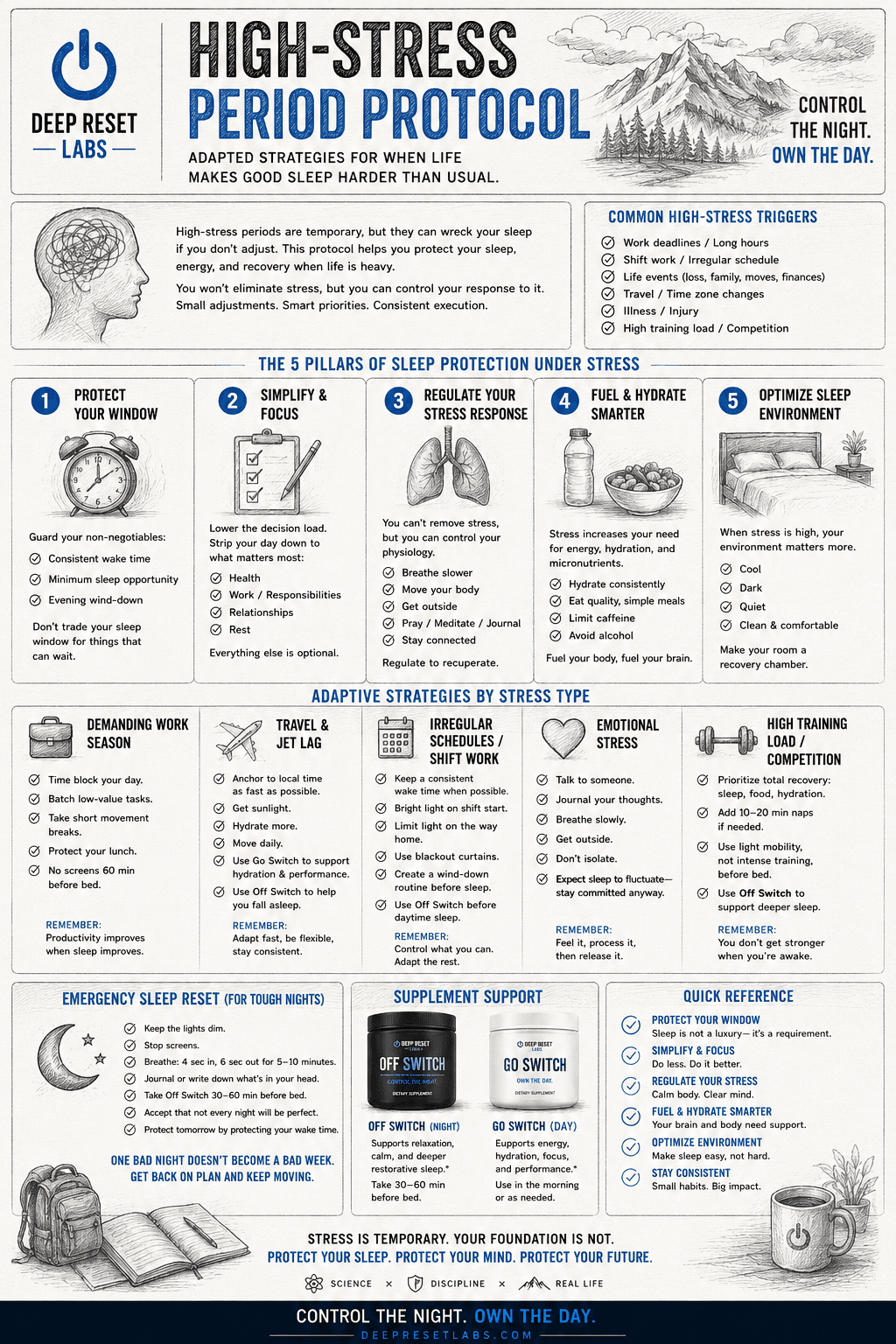
There are times when your normal sleep routine simply is not going to happen. Long shifts. Deadlines. Travel. Family problems. Financial pressure. Emotional stress. Heavy training. A new baby. Unexpected life events.
During these periods, the goal should not be to execute your normal routine perfectly. The goal is to protect the fundamentals, reduce unnecessary stress, and prevent a difficult period from destroying your sleep completely.
You may not be able to control what is happening around you. You can control how you respond to it.
Instead of adding more things to your life, simplify. Your priorities become:
Everything else comes second.
Pillar 1
Protect Your Sleep Window
Guard the Non-Negotiables
Maintain a Consistent Wake Time
When possible, continue waking around your normal time. Your wake time anchors your circadian rhythm and gives your body a predictable starting point each day. If your schedule requires irregular hours, focus on controlling light exposure and creating as much predictability around your primary sleep period as your schedule allows.
Protect Your Sleep Opportunity
Don't voluntarily sacrifice sleep for things that can wait. Sometimes work, family, emergencies, or responsibilities genuinely interfere — but don't turn an unavoidable disruption into an avoidable one by adding another hour of television, social media, work, or scrolling.
Keep Your Wind-Down Routine
Your routine may need to become shorter. That is okay. Even 15–30 minutes of intentional decompression can create separation between the stress of the day and your sleep period. During stressful periods, do not eliminate your routine. Simplify it.
Pillar 2
Simplify & Focus
Reduce the Decision Load
Ask: What Absolutely Needs to Happen Today?
Stress consumes mental bandwidth. Strip your day down to what actually matters. Your priorities may simply be: Health — Work / Responsibilities — Family / Relationships — Sleep / Recovery. Everything else can temporarily move down the list.
Simplify Without Lowering Standards
Meal preparation can become simpler. Training can become shorter. Your evening routine can become shorter. Optional commitments can wait. You are not lowering your standards. You are directing your limited resources toward the things that matter most.
Pillar 3
Regulate Your Stress Response
You Can't Always Remove Stress. You Can Change Your Response to It.
Slow Your Breathing
Try: Inhale 4 seconds → Hold 4 seconds → Exhale 6 seconds. Repeat for 5–10 minutes or for however long feels comfortable. Do not force the breath. The goal is simply slow, controlled breathing.
Move Your Body
Stress does not mean you need to stop exercising. But it may mean changing how you exercise. Walk. Lift moderately. Perform mobility work. Train without trying to set records. Get outside. Movement can remain part of your stress-management strategy without becoming another stressor.
Get Outside
Natural light and movement are two simple tools you can use almost anywhere. Take a short walk. Leave your phone behind when practical. Give your brain a few minutes without additional information coming in.
Use Your Existing Practices
Prayer. Meditation. Journaling. Reading. Breathing. Talking with someone you trust. Use whatever healthy practices consistently help you transition out of a high-alert state. Regulate so you can recuperate.
Pillar 4
Fuel & Hydrate Smarter
Simple Food. Consistent Water.
Prioritize Protein and Whole Foods
Build meals around basic nutrient-dense foods when possible: protein, fruits, vegetables, quality carbohydrates, healthy fats. Simple food eaten consistently is better than skipping meals all day and overeating late at night.
Hydrate Consistently
Start drinking water early and continue throughout the day. If you are working long shifts, training heavily, sweating significantly, traveling, or working in hot conditions, pay additional attention to fluid and electrolyte intake.
Be Careful With Caffeine
Poor Sleep → More Caffeine → More Stimulation → Worse Sleep → More Caffeine. Use caffeine strategically rather than continuously. Try to keep it earlier in your waking period and allow several hours between your final caffeine intake and your planned sleep period.
Limit Alcohol
Alcohol may initially make some people feel sleepy, but it can disrupt normal sleep architecture and contribute to fragmented sleep later in the night. During periods when recovery is already compromised, protecting sleep quality becomes even more important.
Pillar 5
Optimize Your Sleep Environment
Make Your Bedroom a Recovery Chamber
Cool, Dark, Quiet, Clean, Comfortable
Turn the temperature down. Use blackout curtains or an eye mask when needed. Reduce unnecessary noise. Keep your phone away from the bed when practical. Remove work from the bedroom. Dim the lights before sleep.
Control What You Can
You may not be able to control the stress happening outside your bedroom. You can control what happens inside it. Your environment should communicate one thing: it is time to recover.
Adaptive Strategies by Stress Type
Different types of stress require slightly different approaches.
Demanding Work Season
- Time-block important tasks
- Batch low-value work
- Take short movement breaks
- Protect time to eat
- Reduce unnecessary commitments
- Set a stopping point for work
- Aim for 30–60 min without work before bed
Remember
Productivity does not improve indefinitely by extending the workday. Recovery is part of performance.
Travel & Jet Lag
- Adapt to destination schedule as soon as practical
- Prioritize local light exposure
- Stay hydrated
- Move daily
- Eat on local meal timing
- Use Go Switch during the day
- Use Off Switch before your intended sleep period
Remember
Don't expect immediate perfection. Your circadian system needs time to adjust.
Irregular Schedules & Shift Work
- Use bright light when you need to be awake
- Reduce bright light when your shift ends
- Keep the bedroom extremely dark
- Use blackout curtains or an eye mask
- Reduce noise
- Create a short, repeatable pre-sleep routine
- Avoid unnecessary caffeine late in your shift
Remember
Control what you can. Adapt the rest.
Emotional Stress
- Don't try to solve your entire life in bed
- Write down what is on your mind
- Talk with someone you trust
- Pray, meditate, or take a walk
- Breathe slowly
- Write down tomorrow's concerns and give yourself permission to address them tomorrow
Remember
Do not isolate yourself when you are struggling.
Heavy Training or Competition
- Protect your sleep — recovery happens here
- Eat enough, especially protein and carbohydrates
- Stay hydrated
- Use lighter mobility or recovery sessions when needed
- Keep naps short and intentional
- Avoid late-night training when recovery is already limited
Remember
The workout creates the stimulus. Recovery creates the adaptation.
Emergency Sleep Reset
For the nights when your brain will not shut off. When that happens, do not panic and do not start fighting sleep.
Lower the Lights
Turn off bright overhead lighting. Keep the environment dim.
Put the Phone Away
Avoid doom scrolling, social media, stressful news, and work. Do not turn insomnia into entertainment.
Slow Your Breathing
Inhale 4 seconds → Hold 4 seconds → Exhale 6 seconds. Continue for approximately 5–10 minutes.
Empty Your Head
If thoughts keep repeating, write them down. Create a simple list: what you are thinking about and what you can do about it tomorrow. Then stop trying to solve it tonight.
Use Your Normal Sleep Routine
Read. Pray. Meditate. Stretch lightly. Use Off Switch if it is normally part of your routine.
Accept the Night
Do not constantly calculate how many hours of sleep remain. Clock watching creates additional stress. One imperfect night is manageable.
Protect Tomorrow
Get up and return to your normal routine as soon as practical. Get outdoor light. Hydrate. Move. Use caffeine strategically. Give yourself another opportunity to sleep the following night.
One bad night does not need to become a bad week.
Get back on plan and keep moving.
Night
OFF SWITCH
Use approximately 30–60 minutes before your intended bedtime as part of your wind-down routine. Pair with dim lighting, reduced stimulation, slow breathing, and a cool dark bedroom.
The supplement is not the protocol. The entire routine is the protocol.
Day
GO SWITCH
Use during your waking period to support hydration and daytime performance. Pair with water, food, movement, morning light, and smart caffeine use.
Especially useful during travel, heavy training, and high-output work periods.
Your High-Stress Quick Reference
Protect Your Window
Don't voluntarily sacrifice the sleep opportunity you still have.
Simplify & Focus
Do less. Do the important things well.
Regulate Your Stress
Slow your breathing. Move. Get outside. Clear your mind.
Fuel & Hydrate
Your brain and body still need resources when you are stressed.
Optimize the Environment
Make sleep as easy as possible.
The High-Stress Formula
Remember the Goal
During a difficult period, success may mean preventing a stressful week from becoming a stressful month. It may mean getting six hours when circumstances would normally have resulted in four. It may mean choosing a walk instead of another energy drink. It may mean shutting your laptop at 9:00 instead of midnight.
Stress is temporary. Your foundation is not.
Protect your sleep. Protect your recovery. Protect your ability to handle tomorrow.
Control the Night. Own the Day.
Sleep at night
OFF SWITCH
Fall asleep faster, stay asleep longer, and wake up recovered. The nighttime half of the Deep Reset stack.
Shop Off SwitchPerform during the day
GO SWITCH
Hydration, electrolytes, and performance support. Built for the demands of the day.
Shop Go Switch