Protocol
Travel & Jet Lag Protocol
Sleep well. Adapt faster. Stay on mission. How to protect your sleep when your schedule gets disrupted.
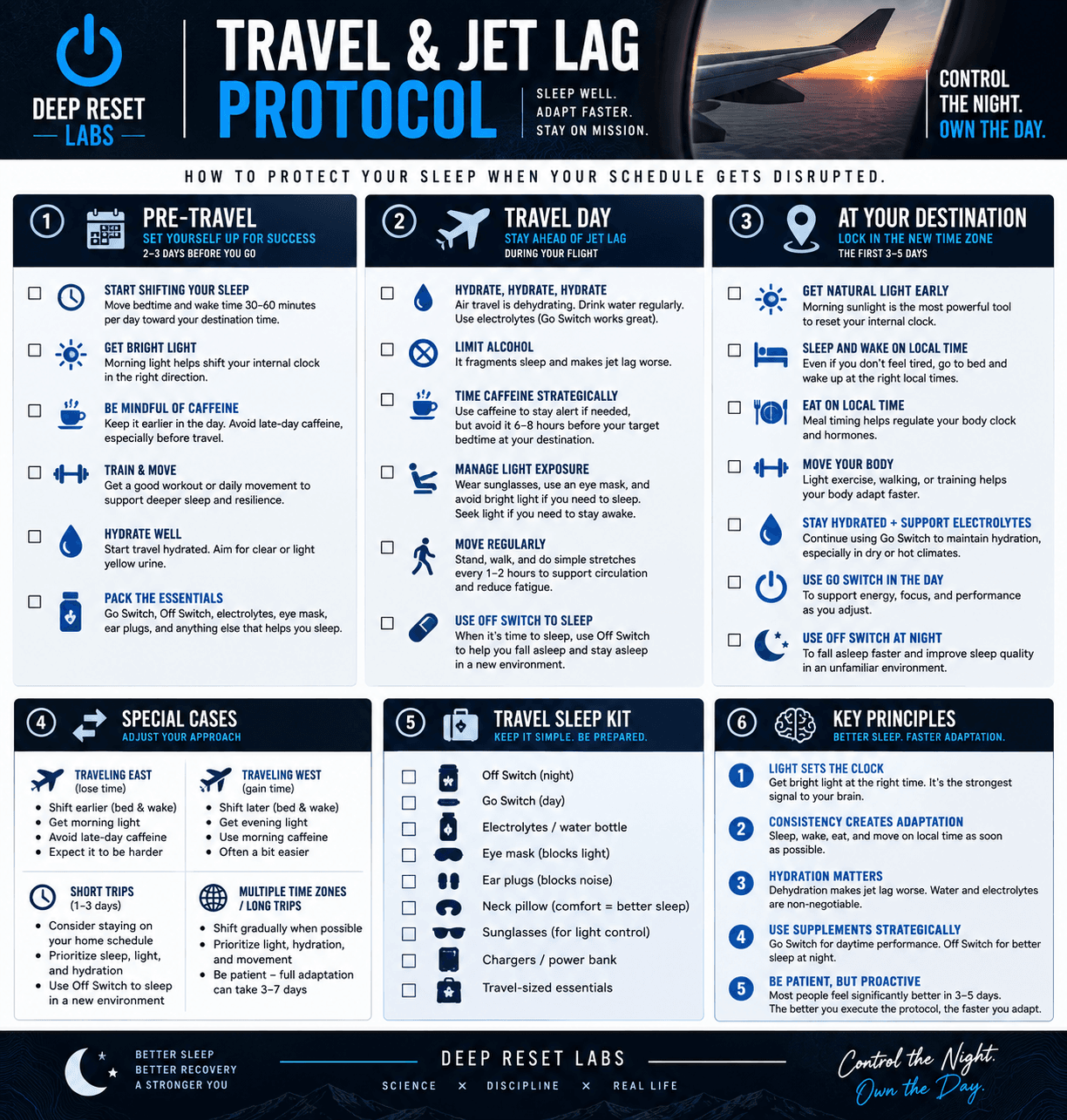
Travel disrupts your circadian rhythm — the internal clock that tells your body when to sleep, wake, eat, and perform. Jet lag is your body's response to a mismatch between your internal clock and the local environment. This protocol gives you a clear framework to minimize that mismatch and adapt as quickly as possible.
2–3 Days Before You Go
- Start Shifting Your Sleep — Move bedtime and wake time 30–60 minutes per day toward your destination time.
- Get Bright Light — Morning light helps shift your internal clock in the right direction.
- Be Mindful of Caffeine — Keep it earlier in the day. Avoid late-day caffeine, especially before travel.
- Train & Move — Get a good workout or daily movement to support deeper sleep and resilience.
- Hydrate Well — Start travel hydrated. Aim for clear or light yellow urine.
- Pack the Essentials — Go Switch, Off Switch, electrolytes, eye mask, ear plugs, and anything else that helps you sleep.
During Your Flight
- Hydrate, Hydrate, Hydrate — Air travel is dehydrating. Drink water regularly. Use electrolytes (Go Switch works great).
- Limit Alcohol — It fragments sleep and makes jet lag worse.
- Time Caffeine Strategically — Use caffeine to stay alert if needed, but avoid it 6–8 hours before your target bedtime at your destination.
- Manage Light Exposure — Wear sunglasses, use an eye mask, and avoid bright light if you need to sleep. Seek light if you need to stay awake.
- Move Regularly — Stand, walk, and do simple stretches every 1–2 hours to support circulation and reduce fatigue.
- Use Off Switch to Sleep — When it's time to sleep, use Off Switch to help you fall asleep and stay asleep in a new environment.
The First 3–5 Days
- Get Natural Light Early — Morning sunlight is the most powerful tool to reset your internal clock.
- Sleep and Wake on Local Time — Even if you don't feel tired, go to bed and wake up at the right local times.
- Eat on Local Time — Meal timing helps regulate your body clock and hormones.
- Move Your Body — Light exercise, walking, or training helps your body adapt faster.
- Stay Hydrated + Support Electrolytes — Continue using Go Switch to maintain hydration, especially in dry or hot climates.
- Use Go Switch in the Day — To support energy, focus, and performance as you adjust.
- Use Off Switch at Night — To fall asleep faster and improve sleep quality in an unfamiliar environment.
Special Cases — Adjust Your Approach
Traveling East
(lose time)
- •Shift earlier (bed & wake)
- •Get morning light
- •Avoid late-day caffeine
- •Expect it to be harder
Traveling West
(gain time)
- •Shift later (bed & wake)
- •Get evening light
- •Use morning caffeine
- •Often a bit easier
Short Trips (1–3 days)
- •Consider staying on your home schedule
- •Prioritize sleep, light, and hydration
- •Use Off Switch to sleep in a new environment
Multiple Time Zones / Long Trips
- •Shift gradually when possible
- •Prioritize light, hydration, and movement
- •Be patient — full adaptation can take 3–7 days
Keep it simple. Be prepared.
- Off Switch (night)
- Go Switch (day)
- Electrolytes / water bottle
- Eye mask (blocks light)
- Ear plugs (blocks noise)
- Neck pillow (comfort = better sleep)
- Sunglasses (for light control)
- Chargers / power bank
- Travel-sized essentials
Better sleep. Faster adaptation.
- 1
Light Sets the Clock
Get bright light at the right time. It's the strongest signal to your brain.
- 2
Consistency Creates Adaptation
Sleep, wake, eat, and move on local time as soon as possible.
- 3
Hydration Matters
Dehydration makes jet lag worse. Water and electrolytes are non-negotiable.
- 4
Use Supplements Strategically
Go Switch for daytime performance. Off Switch for better sleep at night.
- 5
Be Patient, But Proactive
Most people feel significantly better in 3–5 days. The better you execute the protocol, the faster you adapt.
Better sleep. Better recovery. A stronger you. You don't need a perfect trip to perform well — you need a smart protocol. Light, hydration, movement, and consistency are your most powerful tools. Off Switch and Go Switch are built to support you through both.
The Formula
Control the Night. Own the Day.
Sleep at night
OFF SWITCH
Fall asleep faster and stay asleep in a new environment. Your travel recovery tool.
Shop Off SwitchPerform during the day
GO SWITCH
Hydration, electrolytes, and performance support. Built for travel days and destination performance.
Shop Go Switch