Stress & Sleep: Breaking the Cycle
How cortisol disrupts sleep — and what you can do about it.
Stress and sleep are deeply connected. A stressful day can make it harder to sleep, but a poor night of sleep can also make your body more reactive to stress the following day. When that pattern repeats, it can create a cycle of feeling tired during the day but wired when it's finally time to sleep.
Understanding cortisol — and learning how to work with your body's natural stress response — can help break that cycle.
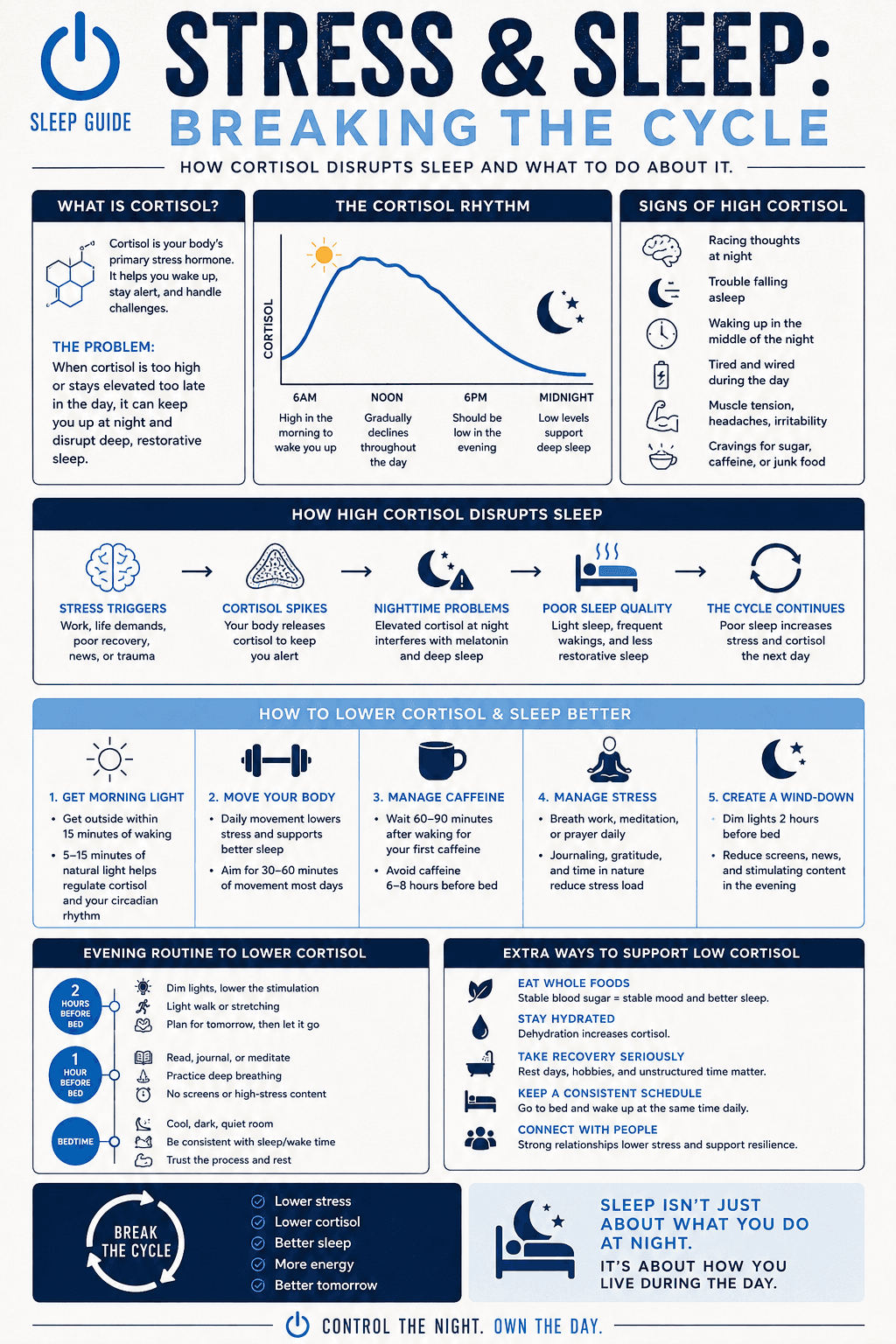
In This Guide
What Is Cortisol?
Cortisol is often called the stress hormone, but cortisol itself isn't bad. It's an essential hormone that helps regulate your metabolism, blood pressure, immune function, energy availability, and response to stress. It also follows a natural daily rhythm.
Under normal circumstances, cortisol rises around the time you wake up, helping your body become alert and ready for the day. Levels generally decline as the day progresses and are lower during the biological night.
Problems can arise when stress and stimulation keep your body in a heightened state when it should be winding down.
The Stress-Sleep Cycle
The cycle can look something like this:
Work demands, family responsibilities, financial pressure, constant notifications, intense training, emotional stress, and other challenges can activate the body's stress response. That's useful when you actually need to perform — but not when you're lying in bed trying to sleep.
If your brain still believes it's time to solve problems, consume information, work, worry, or remain alert, transitioning into sleep can become much more difficult.
Then comes the second half of the cycle. Poor sleep can negatively affect mood, attention, emotional regulation, and how we respond to stressful situations. The following day can feel harder, which can contribute to another stressful evening and another difficult night.
That's the cycle we're trying to break.
Recognize the Signs
Stress-related sleep problems can show up in different ways. You may experience racing thoughts when your head hits the pillow, difficulty falling asleep, frequent nighttime awakenings, or waking earlier than intended. During the day, you may feel fatigued yet unusually wired, irritable, tense, or increasingly dependent on caffeine to maintain your energy.
These symptoms don't automatically mean that you have abnormally high cortisol. Many different factors can cause them. Instead, think of them as signs that it may be worth looking at your overall stress, recovery, and sleep habits.
Start With Morning Light
One of the simplest ways to support your sleep-wake rhythm is to get outside shortly after waking. Aim for 5–15 minutes of natural outdoor light, ideally within the first part of your morning.
Outdoor light provides a strong signal to your brain that daytime has begun and helps synchronize your circadian system.
Think of your morning routine as the beginning of tonight's sleep routine.
Move Your Body
Regular physical activity can be one of the most powerful lifestyle tools for managing stress and supporting sleep. Walk. Lift weights. Do CrossFit. Practice Jiu-Jitsu. Stretch. Hike. Ride a bike. It doesn't have to be complicated.
Aim for regular movement throughout the week while remembering that recovery matters too. More training isn't always better if your body is already under significant physical and psychological stress.
Manage Caffeine Instead of Depending on It
When we're tired, caffeine is an easy solution — but it can also contribute to the cycle. You sleep poorly, so you consume more caffeine. The caffeine helps you function during the day but can remain active into the evening. Sleep suffers again, and the next morning you reach for even more caffeine.
Consider waiting roughly 60–90 minutes after waking before your first caffeine and experimenting with stopping caffeine 6–8 hours before bedtime. Caffeine sensitivity varies considerably, so some people may need an even earlier cutoff.
Give Stress Somewhere to Go
You probably can't eliminate stress from your life. The goal is to develop ways to process it rather than carrying all of it into bed.
Breathing exercises, prayer, meditation, journaling, gratitude, talking with someone you trust, spending time outside, hobbies, and periods without constant digital stimulation can all create opportunities to shift out of a high-alert state.
Sometimes one of the most effective strategies is simply creating a boundary between the demands of the day and the beginning of the night.
Create an Evening Wind-Down
About two hours before bed, begin reducing stimulation. Dim the lights. Step away from stressful work when possible. Reduce news and social media. Take a light walk. Stretch. Prepare what you need for tomorrow so your brain doesn't have to keep rehearsing it.
During the final hour before bed, transition toward quieter activities such as reading, journaling, prayer, meditation, or slow breathing.
You're creating a predictable sequence of cues that tells your brain: The day is over. It's okay to shut down.
Support Recovery During the Day
Stress management isn't only an evening activity. Eat a balanced diet built around whole foods. Stay hydrated. Take recovery days when needed. Maintain meaningful relationships. Spend time doing things that aren't productive, competitive, or performance-driven.
And whenever possible, maintain a relatively consistent sleep and wake schedule. Your nervous system needs periods when it isn't being asked to perform.
Break the Cycle
You don't need to eliminate every source of stress before you can sleep well. Instead, focus on the things you can control:
Better sleep improves your ability to recover. Better recovery can make you more resilient to the stressors you encounter tomorrow. That's how you begin breaking the cycle.
Sleep isn't just about what you do at night. It's about how you live during the day.
Control the Night. Own the Day.
Deep Reset Labs
Support your recovery tonight
OFF SWITCH is formulated to support the exact conditions your body needs to reach and sustain deep sleep — lower cortisol, falling body temperature, and a quiet nervous system.
Shop Off Switch