Understanding Your Sleep Cycles
A deep dive into REM, deep sleep, and how to optimize each stage.
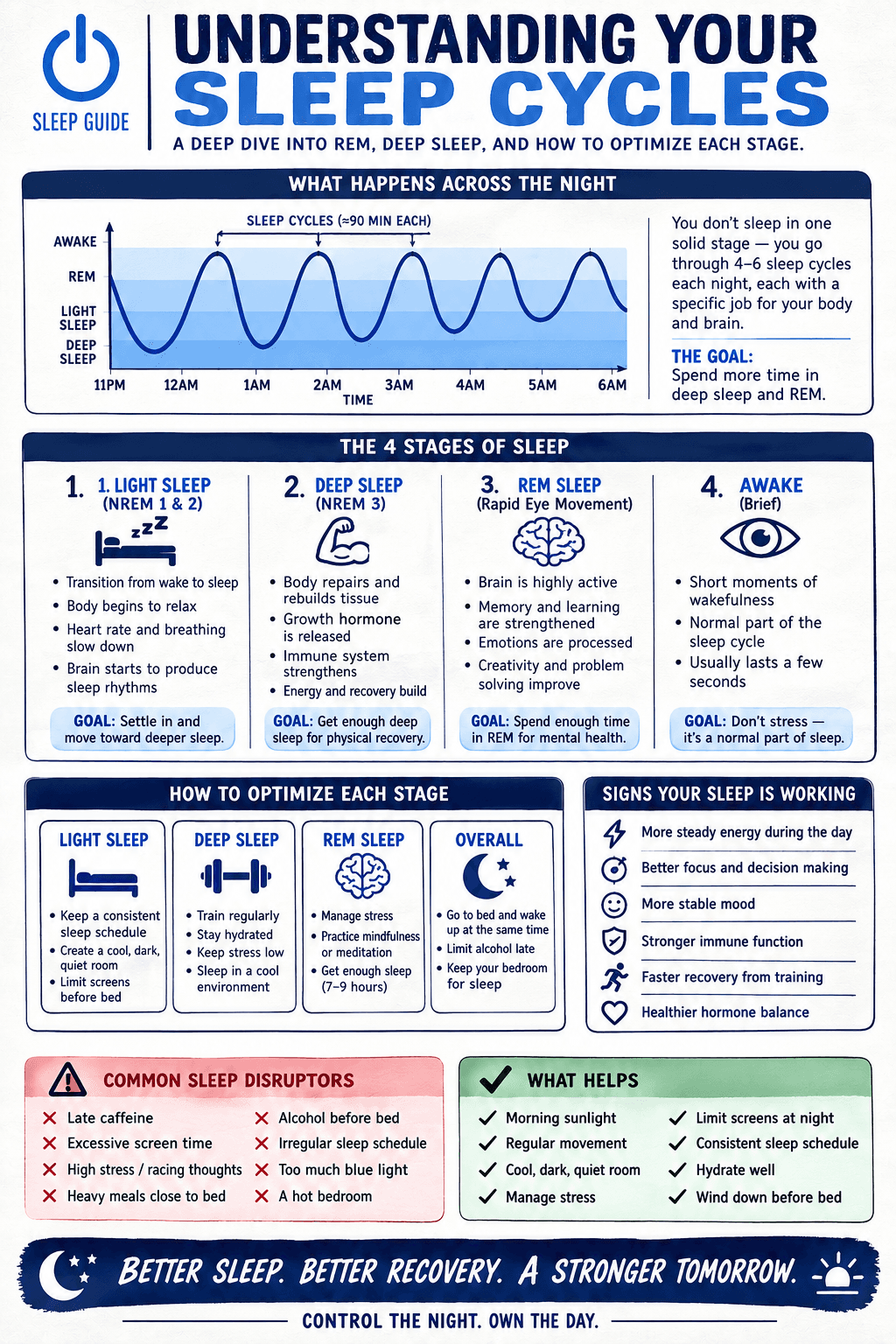
Sleep isn't one continuous state where your brain simply shuts down for eight hours. Throughout the night, your brain and body move through a repeating sequence of different sleep stages, with each stage playing a different role. A typical cycle lasts roughly 80–100 minutes, and most people complete about 4–6 cycles per night.
The amount of time spent in each stage also changes as the night progresses. Understanding these cycles can help explain why sleep quality, timing, and duration all matter.
In This Guide
The Four Stages of Sleep
Sleep is divided into two major types: non-REM (NREM) sleep and REM sleep. NREM sleep contains three stages—N1, N2, and N3—followed by periods of REM sleep.
Stage 1: Light Sleep — NREM 1
This is the transition between being awake and being asleep. Your muscles begin to relax, your breathing and heart rate start slowing, and you become less aware of your surroundings. You are still relatively easy to wake during this stage. Think of Stage 1 as the entry point into sleep. Creating a dark, quiet, comfortable environment and developing a consistent wind-down routine can make that transition easier.
Stage 2: Light Sleep — NREM 2
Once you reach Stage 2, you are fully asleep. Your heart rate slows, body temperature drops, and your brain begins displaying characteristic patterns of activity associated with sleep. You normally spend a substantial portion of the night in this stage. Although we call it "light sleep," it is not wasted time. Stage 2 is a normal and important part of progressing through a complete sleep cycle.
Stage 3: Deep Sleep — NREM 3
This is what most people think of when they hear deep sleep or slow-wave sleep. During deep sleep, heart rate and breathing slow and the body is deeply relaxed. This stage is associated with physical restoration, and it is generally much harder to wake someone from deep sleep than from lighter stages. Interestingly, deep sleep is not distributed evenly throughout the night. You generally get more deep sleep earlier in your sleep period. That makes protecting the first several hours of sleep especially important.
Stage 4: REM Sleep
REM stands for Rapid Eye Movement. During REM sleep, brain activity becomes much more active and resembles patterns seen while you are awake. Dreaming commonly occurs during REM, your eyes move rapidly behind your eyelids, and most skeletal muscles become temporarily inactive. Unlike deep sleep, REM periods generally become longer later in the night. This is one reason cutting your sleep short in the morning does not simply eliminate extra sleep—you may be cutting into a REM-rich portion of your night.
Your Sleep Architecture Changes Throughout the Night
You don't simply complete the same identical 90-minute cycle over and over. Early in the night, you generally spend more time in deep NREM sleep. As morning approaches, deep sleep becomes less prominent and REM periods tend to become longer. Brief awakenings between cycles can also occur and aren't necessarily abnormal.
So rather than obsessing over achieving a specific percentage of REM or deep sleep every night, focus on creating enough opportunity for your brain to move naturally through its cycles.
How to Support Better Sleep Cycles
You can't consciously decide to enter deep sleep or REM. What you can control is the environment and behaviors surrounding your sleep.
Maintain a consistent sleep and wake schedule.
Give yourself enough time to sleep.
Keep your bedroom cool, dark, and quiet.
Exercise regularly.
Reduce bright light and stimulation as bedtime approaches.
Be mindful of caffeine and alcohol, which can interfere with sleep.
These habits aren't about “hacking” one individual sleep stage. They're about giving your brain the opportunity to produce normal, healthy sleep architecture on its own.
Don't Chase the Perfect Sleep Score
Wearable devices can be useful for identifying trends, but the goal isn't to achieve a perfect sleep score every night. Pay attention to how you actually function. Are you waking up feeling reasonably refreshed? Do you have steady energy throughout the day? Can you concentrate? Are you recovering from training? Are you constantly fighting the urge to fall asleep?
Sleep quality and sufficient sleep affect attention, learning, physical health, and your ability to function during the day.
Protect the Whole Night
Instead of asking: “How do I get more deep sleep?” or “How do I increase REM?”
Start with a better question: “How can I give my body the best opportunity to complete healthy sleep cycles tonight?”
Protect your sleep opportunity. Build a consistent schedule. Control your environment. Manage caffeine and evening stimulation. Get regular movement and daytime light exposure. Then allow your brain to do what it's designed to do.
Better sleep isn't about maximizing one stage. It's about allowing your brain and body to move through the entire cycle—again and again throughout the night.
Sleep Smart. Recover Better.
Control the Night. Own the Day.
Deep Reset Labs
Put the science to work
OFF SWITCH is formulated to support the exact conditions your body needs to reach and sustain deep sleep — lower cortisol, falling body temperature, and a quiet nervous system.
Shop Off Switch